Retail denial: Why automotive strategies are dying in the showroom

Retail denial: Why automotive strategies are dying in the showroom

Automotive retail is currently suffering from a dangerous disconnect. While many head offices are moving away from a single sales model in favor of flexible hybrid arrangements, a new gap is opening between strategy and reality.

These hybrid models are designed to find a perfect balance: OEMs can act as agents for high-value products to maintain brand control, while dealers keep their independence in other areas to stay responsive to their local markets. It sounds like the perfect compromise, but the execution is falling further behind. We are seeing an industry-wide “denial gap,” where the sheer complexity of managing these blended roles is quietly suffocating the very transformations designed to save the network.

We launched our nine-week Sales and Revenue Transformation campaign to move beyond theoretical discussions and uncover where the commercial journey is actually breaking down. By examining the transition to these new hybrid models and the resulting pressure points in retail and service, we aimed to identify the practical barriers that prevent MSX clients – both OEMs and dealer groups – from recovering lost revenue.

The feedback from over 500 automotive specialists, retail leaders, and commercial experts who participated in our research was clear: the industry doesn’t have a strategy problem. It has an execution crisis.

Across the campaign, the findings pointed to the same underlying issue. 47% of respondents identified consistent execution as the hardest part of managing a consolidating dealer network, while 52% said rules interpretation creates the greatest risk in complex incentive programs. In both cases, the challenge is clear: strategy only delivers value when people across the network can understand it, apply it, and act on it consistently.

Graph showing 47% struggle with consistent execution in automotive retail.

This is the point where high-level strategy often meets a dead end. A transformation only matters if it changes what happens between a salesperson and a customer, or a service advisor and a vehicle owner. If it doesn’t scale consistently across every market and every touchpoint, it isn’t transformation – it’s just paperwork.

Changing the sales model won’t fix a visibility problem

The industry is racing toward agency and hybrid models in search of control. But control requires clarity. Our research found that role clarity and network visibility were the primary concerns for 32% of respondents in these new models.

Graph showing 32% of respondents cite role clarity and network visibility concerns.
If a dealer doesn’t know where their responsibility ends and the OEM’s begins, the customer will be the first to find out. MSX CX Consultancy helps brands bridge this gap by redesigning journeys that actually function in a multi-channel world. To protect conversion at the digital stage, solutions like MSX E.COM Personal Landing Pages and MSX Consumer Engagement Solutions ensure that the customer doesn’t fall through the cracks of a disconnected handoff.

Scale is currently the enemy of consistency

As dealer groups consolidate, they gain massive scale – but they often lose grip on the “how.” When nearly half of the industry says consistency is their biggest headache, it proves that “bigger” isn’t “better” without a way to steer the ship.

You cannot manage a global network through a rear-view mirror. MSX ENGAGE provides the alignment necessary to keep large groups moving in unison, while APPRAISO turns static compliance into dynamic performance steering. If you can’t see the gap, you can’t close it.

Incentive complexity is an execution problem

Incentive schemes only steer behavior if the network understands them. Our research found that 52% of respondents identify rules interpretation as the greatest risk in complex programs, far outweighing concerns over audit readiness.

When rules are open to interpretation, inconsistency quickly erodes claims accuracy and partner trust. MSX Sales Incentive Audit program can support automotive brands in strengthening the governance, clarity, and audit trail behind incentive programs, helping ensure commercial activity is measured and rewarded with greater confidence.

Aftersales is where your revenue is leaking

While the industry obsesses over the “new car” sales model, the largest profit pool – aftersales – is under-managed. 34% of respondents identified service booking as the number one source of revenue leakage, outranking online leads and showroom follow-ups.

Graph showing 34% revenue leakage from service booking in automotive industry.

We are seeing a market where customers prioritize speed and ease over brand loyalty. If your booking journey is a barrier, your revenue is already gone. In the article Is convenience killing the automotive service industry?, we highlight that convenience is the new currency. MSX Mobile Service is a direct response to this, reclaiming capacity and utilization by meeting the customer where they are, rather than waiting for them to show up.

Data is noise if it doesn’t drive coaching

We are drowning in data but starving for insight. 30% of professionals told us that coaching impact and service performance are their biggest blind spots.

As we explored in Is the traditional KPI dead?, reporting what happened last month is no longer a management strategy. MSX Sales Performance uses diagnostics to uncover the why behind the numbers, ensuring that every intervention is targeted and measurable.

Stop training, start coaching

Perhaps the most telling finding was that 34% of respondents blame inconsistent coaching for stalling sales improvement, while 29% cited low adoption.

Graph showing coaching and adoption gap in automotive sales strategies.
The traditional “classroom” approach to retail improvement is failing. Change only happens when it is reinforced locally and daily. MSX COACH and our wider Learning Solutions move capability building out of the HR department and into the showroom flow, ensuring that strategy actually translates into behavior.

High stakes for high performance

The automotive retail landscape is being rebuilt. Whether the resulting structure is profitable or simply more complex depends entirely on your ability to close the gap between what you say you will do and what your network actually delivers. Transformation should not be a pilot program that never reaches scale; it should be the standard.

Your strategy is only as good as its last mile. If your transformation isn’t reaching the showroom floor, it isn’t delivering value.

Don’t let your strategy stall at the showroom door. Contact MSX to discuss how we can help you bridge the gap between strategy and a high-performing network.

Related Articles

Fleet performance is decided long before the vehicle leaves the fleet

Fleet performance is decided long before the vehicle leaves the fleet

There is a point in every fleet lifecycle when earlier decisions become visible. It may happen when maintenance costs rise sharply after warranty. It may happen when vehicles spend too much time off the road. Or it may happen at remarketing, when the final value of a vehicle reflects everything that came before it. Although these issues may appear unrelated, they often share the same root cause: the decisions made throughout the vehicle’s lifecycle.

Fleet performance is not defined by one event. It is shaped by thousands of decisions about maintenance, repairs, vehicle use, supplier performance, data management and customer support. Every decision influences the next stage of the lifecycle.

As fleet operations become more complex, understanding these connections is becoming a competitive advantage.

Looking beyond individual events

Many organizations still manage fleet operations as a series of separate activities. Maintenance, operations, procurement, finance and remarketing each focus on their own priorities. This approach creates blind spots. Maintenance teams monitor repairs. Finance measures cost. Operations track vehicle availability. Customer teams focus on service quality. Remarketing teams concentrate on residual values. Each perspective is valuable, but none provides a complete picture.

For leasing companies in particular, every part of the vehicle lifecycle is connected. Decisions that reduce costs today may increase downtime tomorrow. A repair completed quickly may influence future resale value. A gap in service history may only become visible when the vehicle reaches the used vehicle market.

Managing these activities independently makes it difficult to understand how today’s decisions affect tomorrow’s performance.

Maintenance is an investment, not simply a cost

Maintenance provides one of the clearest examples of this connected thinking. It is often viewed as an operational requirement or a cost to control. In reality, it is one of the strongest drivers of vehicle uptime, customer satisfaction and long-term asset value.

The more important question is not whether a vehicle has been maintained. It is whether it has been maintained in a way that protects performance throughout the rest of its lifecycle.

A recent project by MSX demonstrates this clearly. Working with a middle-mile logistics provider, the team analyzed warranty and maintenance data as a large proportion of the client’s fleet approached the end of its warranty period. Rather than waiting for repair costs to increase, the objective was to understand where future risks were likely to emerge.

Using reliability modelling and survival analysis, MSX identified how failure rates for key vehicle components would change over time and mileage. This enabled the client to move from reactive repairs to a more targeted preventative maintenance strategy.

The findings were significant. Without intervention, major repair costs were projected to increase by 227% after warranty expiry. A more proactive maintenance strategy had the potential to avoid up to US$13 million in annual repair costs.

The figures themselves are specific to this project, but the lesson is universal. The decisions made while a vehicle is in service have a direct impact on future operating costs, uptime and asset value.

Electric vehicles introduce a new lifecycle challenge

The growth of electric vehicles (EVs) makes lifecycle management even more important. Although EVs simplify some aspects of maintenance, they also introduce new considerations. Battery health, charging behavior, software updates, thermal management and diagnostic capability all influence vehicle performance throughout its life.

Two EVs with identical mileage may have very different long-term value depending on how they have been operated and maintained. This becomes particularly important when vehicles reach remarketing. Buyers are no longer evaluating only the vehicle itself. They also want confidence in the condition of the battery, the quality of the service history and the availability of accurate technical information. That confidence cannot be created at the point of resale. It must be built throughout the vehicle’s operational life.

For leasing companies, this makes lifecycle management as much a commercial discipline as a technical one.

Remarketing begins much earlier than resale

Remarketing is often viewed as the final stage of the vehicle lifecycle. In reality, it reflects everything that came before it. Residual value is influenced by maintenance quality, repair decisions, damage management, service documentation, refurbishment planning and vehicle condition. Every stage contributes to the final outcome.

For EVs, documentation becomes even more valuable. Clear records of battery condition, software updates and servicing help reduce uncertainty for buyers and support stronger resale values. This means protecting residual value cannot be left to remarketing teams alone. It requires organizations to ask broader questions throughout the vehicle’s life.

When these questions are considered earlier, remarketing becomes a measure of lifecycle performance rather than simply a sales process.

From more data to better decisions

Most fleet organizations already possess extensive operational data. The challenge is not collecting more information. It is connecting the information that already exists.

A rise in maintenance costs may indicate changing component reliability. Increased downtime may highlight supplier performance issues. Battery health data may become an indicator of future residual value. Missing service records may reduce buyer confidence long before a vehicle reaches the used market. Viewed individually, these signals offer only limited insight. Viewed together, they provide a clearer understanding of where operational risk is developing and where intervention will have the greatest impact.

Technology plays an important role, but data alone is not enough. Effective lifecycle management combines data with operational expertise, enabling organizations to make decisions that are commercially sound, technically practical and focused on long-term performance.

A more connected approach to fleet performance

Fleet and leasing companies face increasing pressure to improve efficiency while controlling costs, maximizing uptime and protecting residual values. At the same time, the transition towards more diverse fleets, changing customer expectations and increasing operational complexity means traditional approaches are becoming less effective.

The next stage of fleet performance will not come from optimizing individual processes in isolation. It will come from understanding how every stage of the vehicle lifecycle influences the next. MSX helps organizations connect these dots, transforming individual decisions into a cohesive strategy that protects asset value and improves long-term profitability.

Connect with us today to move beyond managing individual events and start mastering the lifecycle intelligence that drives your fleet’s total performance.

Contact the Author

Round-images (2)

Amedeo Raise

Head of Fleet Solutions

Round-images (2)

Amedeo Raise

Head of Fleet Solutions

Related Articles

The profit lifecycle: Where automotive profit is really won

The profit lifecycle: Where automotive profit is really won

Stop looking for profit in the wrong places. Profit is often viewed as the result of financial performance. It appears in margin reports, return on sales figures, aftersales revenue, and year-end results. Those measures matter, but they only tell part of the story. They show the outcome, not how it was achieved.

The reality is that profit is created, protected, and sometimes lost long before it appears on a financial statement. It starts when a vehicle enters the market and continues through every customer interaction, service visit, repair, recall, and operational decision that follows.

Between market entry and aftersales, the sales journey also plays a critical role in profitability. Solutions such as E.COM Personal Landing Pages and APPRAISO help brands strengthen customer engagement, support retailer performance, and create value from the moment a vehicle becomes available.

The organizations that consistently outperform their competitors understand that profitability is not owned by one department. It is influenced by how effectively the entire business works together. Faster market entry. Better repair quality. Reduced vehicle downtime. Smarter customer engagement. More efficient recalls. Stronger technical support. These may be viewed as separate activities, but each plays a role in shaping commercial outcomes. The most successful automotive businesses are beginning to connect these dots. They are shifting their focus from measuring profit at the end of the journey to understanding how value is created at every stage of it. Because in today’s automotive industry, profit doesn’t simply appear in the numbers. It follows the vehicle. It begins before the vehicle reaches the customer.

Homologation is often treated as a compliance task. In reality, it affects launch timing, internal coordination, retailer readiness, and time to market. When approvals move smoothly and documentation is well managed, businesses protect commercial momentum. When they do not, delay becomes cost. That is one reason MSX Homologation Services matter from a profitability point of view, not only a regulatory one

Once the vehicle is in market, profit becomes even more operational.

A sale creates revenue. The ownership journey determines how much value is retained and grown. Service access, technical accuracy, convenience, recall execution, and customer communication all shape whether a customer stays loyal and whether the network runs efficiently. This is where many organizations still underestimate margin loss.

In Is convenience killing the automotive service industry?, MSX highlighted something the industry is feeling every day: convenience has become a real driver of customer retention. If customers cannot book quickly, get clear updates, or access flexible service options, the cost is not only dissatisfaction. It is missed revenue, weaker retention, and lower lifetime value.

Customer engagement shows the same pattern. A leading automotive brand improved call conversion by 18% and achieved a further 6% conversion uplift through WhatsApp by moving from static outreach to real-time, needs-based contact. Better timing. Better relevance. Better results. Read the full story  .

Inside the workshop, profit is shaped by speed and clarity.

When technicians spend too long searching for repair information, or support teams are buried in repeat queries, productivity falls and downtime rises. In validation work with a leading multinational manufacturer, the MSX AI Virtual Assistant reduced support tickets by 30% and improved response times by 15% by helping technicians access technical service bulletins, repair manuals, and diagnostic trouble codes faster. That is operational efficiency with a direct commercial effect.

Repair quality is another area where workshop performance shapes profitability in ways that are easy to overlook. Repeat repairs, inconsistent diagnosis, and poor repair order discipline all create cost: rework, warranty exposure, customer dissatisfaction, and avoidable operational expense. MSX Repair Quality Support addresses this through a structured, data-led program that helps OEMs and dealer networks improve first-time fix rates (FTFR), standardize repair execution, and prioritize intervention where it has the greatest impact. The results are measurable: up to a 5% improvement in first-time fix and up to a 20% productivity increase across the network.
The same is true for technical content. Documentation often sits in the background, but slow publishing cycles and fragmented authoring processes create friction across the network. pubFoundry helps improve content flow, consistency, and speed, which supports better service performance and more efficient knowledge sharing.
A wider shift is happening here too.

This shift is changing how automotive businesses think about performance. In Beyond the numbers and Is the traditional KPI dead?, MSX explored why historical KPIs alone are no longer enough. Organizations need better context, better prediction, and a clearer understanding of what is driving performance – not just what has already happened.

That shift matters because profit is easier to protect when organizations can see problems early and act before cost becomes visible.

Profit is easiest to lose when complexity increases.

Recalls also deserve a place in the profit conversation. Poorly managed recalls do more than add cost. They put pressure on capacity, frustrate customers, and weaken trust. MSX Recall Management helps coordinate scheduling, capacity, and customer contact so that recalls are completed more efficiently and with less disruption. For fleet operators and mobility providers, lifecycle risk makes the point even more clearly. In this customer success story: Increasing fleet reliability, MSX showed how a preventative maintenance model could help a logistics operator avoid up to $13 million in annual spend. That is what happens when data is used early enough to protect value before cost becomes visible.

So where is profit really created?

Across all of these examples, the message is consistent: Profit is shaped through operational decisions, customer experience, service efficiency, compliance readiness, technical support, and lifecycle management.

In other words, profit follows the vehicle. The organizations that understand the profit lifecycle will be better positioned to identify hidden margin loss, strengthen customer loyalty, and create sustainable performance at every stage of the journey.

The question is not whether profit is being won or lost. The question is where.

Which stage of the vehicle lifecycle has the greatest impact on profitability in your organization? Connect with us to continue the discussion.

Related Articles

MSX Lifecycle Optimization: Navigating the Fleet Lifecycle

Home > Articles > MSX Lifecycle Optimization Navigating The Fleet Lifecycle.

MSX Lifecycle Optimization: Navigating the Fleet Lifecycle

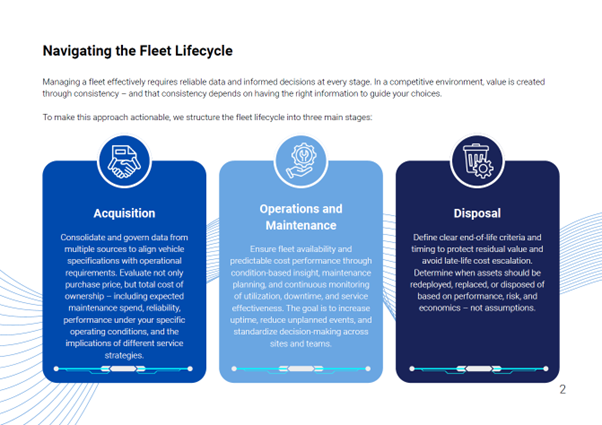
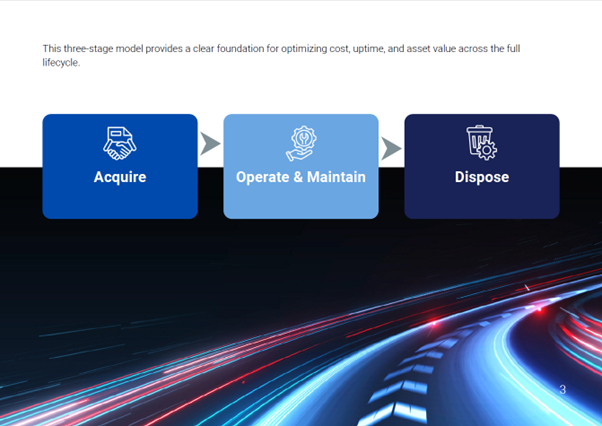
Every hour a vehicle is off the road, your business feels it. Yet many fleets are still maintained on generic schedules and incomplete data, leading to avoidable failures, unpredictable costs, and shorter asset life. MSX Lifecycle Optimization applies advanced analytics and deep vehicle expertise to help you design and run a maintenance strategy that reflects how your fleet really operates – across acquisition, operations and maintenance, and disposal.

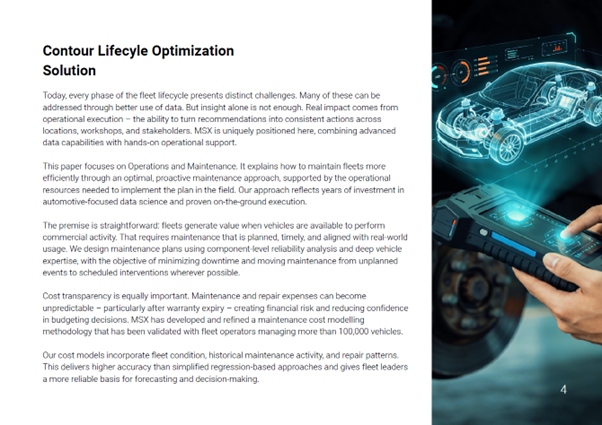
This report focuses on the operations and maintenance phase. It shows how a data-driven, proactive approach to maintenance can reduce unplanned downtime, improve cost visibility, and extend the productive life of your vehicles. Managing a modern fleet means making better decisions, faster – and backing them with reliable data.

Download the full report and discover how MSX can help you reduce unplanned maintenance, stabilize costs, and extend asset value across your fleet.

To stay informed about upcoming reports and events from MSX, submit your detail below.
Don’t miss out on new insights and discussions with our leadership team.

We’d love to hear from you

If you’d like to know more about MSX or how we can support your business, please fill out the form below.


Related Articles

The data cycle: Where insights drive actions, and actions fuel insights

The data cycle: Where insights drive actions, and actions fuel insights

Field operations are one of MSX’s most influential capabilities because transformation happens where customers interact with your brand. Every year, we visit and coach thousands of retail locations, and that number continues to grow. These engagements are not routine checks, but strategic interventions designed to elevate performance, customer experience, and profitability.

OEMs recognize the value of this service because, in today’s highly analytical era, success demands more than intuition. It requires rigorous evaluation, actionable insights, and alignment with evolving customer expectations. Field operations bridge the gap between strategy and execution, ensuring every recommendation is grounded in evidence and tailored to real-world conditions.

Analytical practices have matured and so have the tools behind them. Advances in data engineering, governance, cataloguing, and generative AI have redefined what’s possible. These capabilities allow us to move beyond static reporting to dynamic, predictive insights – delivering multiple KPIs and repeatable, high-quality analysis at speed. We can now identify which operational practices drive measurable improvements in customer satisfaction and replicate those successes across entire networks.

Redefining value

Calculating the ROI of field programs has always been complex. At MSX, we’re committed to solving that challenge with transparency and precision. Our ambition is to transition every field operations program to a pay-for-performance model – a bold move that aligns our success with yours. By linking compensation to measurable outcomes, we reduce risk for OEMs, demonstrate accountability, and prove the value of every intervention with data-driven evidence.

Precision in practice

One of the biggest hurdles in measuring program impact occurs when participants are not selected at random. This can make results misleading, as differences may stem from factors like size, location, or experience rather than the program itself. A simple A/B test often falls short in these cases. However, when control and treatment groups are randomized, A/B testing becomes a powerful methodology – enabling us to uncover and validate cause-and-effect relationships between variables and their impact on business performance. This creates a precise benchmark for informed business discussions.

Beyond single experiments, our technical capabilities allow us to run multiple tests simultaneously, optimizing operational practices and recommendations in real time.


Your data is just the starting point. We enrich it with hundreds of additional datasets from internal sources and world-class partners to give you a panoramic view of performance. This expanded dataset enables broader benchmarking so you can see how your network compares internally and against industry leaders. It positions your success in the context of competitive standards, helping you identify where you outperform and where improvement is needed.

By combining your operational KPIs with regional market data, we can pinpoint which service practices deliver the highest customer satisfaction in similar markets. Accuracy ensures these insights are based on validated, reliable data, while transparency means you understand the methodology behind every recommendation. This clarity empowers you to make strategic decisions with confidence – whether that’s reallocating resources to high-performing regions, refining training programs, or introducing new customer experience initiatives.

Unearthing the full picture

The numbers tell part of the story – but not all of it. While quantitative data reveals trends and performance metrics, qualitative insights uncover the “why” behind those patterns. Our tools integrate both dimensions seamlessly. By applying propensity score matching – a method that creates fair comparisons by matching entities with similar characteristics – we eliminate bias and ensure evaluations reflect true impact. This means you’re not just comparing dealerships by size or geography – you’re benchmarking performance against peers with similar operational realities.

At the most granular level, we track practice adoption and assess implementation quality. This allows us to answer critical questions: Are the recommended processes being followed? How effectively are they executed? These insights highlight gaps that raw numbers can’t capture, such as cultural barriers or training needs that influence outcomes.

Turning insight into action

Empowering our field teams is fundamental to driving transformation. We equip them with actionable data and encourage critical thinking, enabling them to interpret insights rather than simply report them. This blend of quantitative evidence and qualitative context ensures recommendations are not only statistically significant but also practical and tailored to real-world conditions.

A data model might show that a specific service process improves customer satisfaction scores. But qualitative feedback from the field could reveal that adoption is slow due to resource constraints. By combining these perspectives, we design interventions that are both effective and feasible – whether that means adjusting training programs, reallocating resources, or refining operational guidelines. This integrated approach turns field teams into strategic partners, capable of influencing outcomes and shaping best practices across the network.
The road ahead is complex, but MSX has the expertise to navigate it. We’ve iterated across multiple OEM datasets, refining our approach to causal analysis and preparing for rollout at scale. Our internal data capabilities are evolving to meet – and exceed – the challenges facing mobility players today.

If you’re ready to turn data into a competitive advantage and transform your field operations into a performance-driven engine, let’s start the conversation.

Connect with MSX today and discover how we can help you lead the future of mobility.

Contact the Author

Felipe_Cruz

Felipe Cuz

Global Solutions Leader, Actionable Insights

Felipe_Cruz

Felipe Cruz

Global Solutions Leader, Actionable Insights

Related Articles

Accessory Sales Reimagined: APIP unlocks 110% sales boost through structured modular implementation

Accessory Sales Reimagined: APIP unlocks 110% sales boost through structured modular implementation

Fast facts

Dealer network of a leading volume manufacturer

Accessory sales were hindered by fragmented departmental ownership, lack of incentives and training, and workshop capacity pressures, resulting in missed revenue opportunities and lost business to aftermarket providers.

UK

MSX Accessories Performance Improvement Program (APIP) transformed accessory sales into a structured, customer-focused strategy that delivered rapid performance gains, boosted revenue, and significantly improved dealership engagement and customer satisfaction.

Identifying the barriers to accessory sales growth

Accessories have traditionally been a neglected aspect of the vehicle sales process, often falling into the gaps between parts, service, and sales departments. In many dealerships, this meant that accessories were rarely discussed with customers, and sales teams lacked both the training and the incentive to promote them. For a leading volume vehicle manufacturer in the UK, this resulted in accessory sales being treated as an afterthought, despite the brand’s strong accessory portfolio and the clear potential to drive additional revenue and customer satisfaction.

The challenge was multifaceted. Ownership of accessory sales was fragmented across departments, leading to inconsistent processes and a lack of accountability. Sales teams were not confident in selling accessories, while parts departments operated in silos and service teams were preoccupied with warranty and recall work. This disconnect meant that valuable business was routinely lost to aftermarket providers, often simply because customers were unaware of the OEM-approved solutions available to them.

Compounding these issues were broader industry pressures. The manufacturer faced ongoing capacity constraints in workshops, driven by technician shortages and the need to prioritize warranty and recall work. As a result, finding new ways to grow customer-paid revenue became even more critical. Accessories, with their high margin potential and ability to enhance the ownership experience, represented a significant untapped opportunity.

Recognizing these challenges and the need for a more proactive approach, the manufacturer partnered with MSX to fundamentally transform the role of accessories within the sales journey. The goal was to shift accessories from a reactive, last-minute add-on to an integrated, strategic sales channel, unlocking new value for both the business and its customers.

Insight-led, performance-driven, and dealer-focused

To address these challenges, MSX and the manufacturer launched the Accessories Performance Improvement Program (APIP) across selected UK dealerships. The initiative was designed not only to boost accessory sales but to fundamentally reshape how accessories were perceived and sold within the dealership environment. By turning a traditionally reactive and fragmented process into a structured, customer-focused strategy, the program aimed to bridge departmental silos, empower sales teams, and unlock a new stream of customer-paid revenue. It also sought to relieve pressure on workshop capacity by shifting focus toward high-margin, easy-to-fit accessories that could be sold proactively at the point of vehicle purchase. The solution was built on three core pillars:

  • Strategic product focus

    Working closely with OEM stakeholders, MSX identified high-impact accessories – such as dash cams and protection packs – for targeted promotion. These products were chosen for their ease of fitment, customer appeal, and margin potential.

  • Data-driven dealer targeting

    Dealerships with low accessory sales-to-vehicle sales ratios were prioritized for the program. A comprehensive audit process, including mystery shopping, online presence reviews, and in-store observations, established a clear baseline for each dealership.

  • Structured on-site coaching

    MSX consultants conducted hands-on health checks, aligning parts, service, and sales teams around a unified accessory sales strategy. This included embedding accessories into the car deal conversation, removing accessories from used cars to enable resale and upsell opportunities, and implementing cross-departmental incentives to drive engagement.

Engaging dealer principals and department leads at an early stage of the implementation phase helped ensure buy-in, incentivizing sales teams, and integrating accessories into the standard sales script. Quick-win process tweaks – such as bundling accessories into finance offers – delivered immediate impact, while positioning accessories as value-added enhancements improved customer satisfaction. Performance was tracked through regular reviews and dashboards, ensuring transparency and continuous improvement.

Accelerating growth with purpose

The APIP Program delivered rapid and measurable results for the manufacturer and its dealer network. By embedding accessories into the sales conversation and aligning cross-functional teams around a shared strategy, dealerships were able to unlock previously untapped revenue streams and improve customer engagement. The program’s structured approach and practical coaching enabled dealers to implement changes quickly, with minimal disruption to existing workflows. This not only accelerated performance but also demonstrated the scalability of the model across different dealership profiles. Dealerships reported fast results, practical implementation, and high credibility of MSX consultants. The program successfully transformed accessory sales into a proactive profit center, delivering greater value and customization for customers, without adding pressure on workshop capacity.

Here’s how the program delivered measurable impact:

year-on-year increase in targeted
accessory pack sales
+ 0 %
year-on-year growth in promoted
products such as dash cams
+ 0 %
accessory sales growth in mature
program dealerships over three years
+ 0 %

Practical insight, lasting change

The program highlighted the importance of dealer engagement and cross-functional collaboration. Securing buy-in from dealer principals and aligning all departments were critical to success, while practical, hands-on coaching and quick-win process tweaks drove rapid adoption and results. Positioning accessories as personalization options not only boosted sales but also enhanced the customer experience.

Early pilots with luxury brands indicate even greater potential due to higher accessory value per vehicle, and the APIP model is well-positioned for broader rollout across markets and segments. Future enhancements may include digital tools for accessory visualization and further integration with finance offers.

In summary, MSX’s Accessories Performance Improvement Program unlocked significant untapped potential for the manufacturer’s UK dealer network. Through structured coaching, cross-functional collaboration, and a clear incentive model, the program transformed accessories from a neglected afterthought into a dynamic profit center, delivering measurable growth, enhanced customer value, and a blueprint for future expansion.

If you’d like to find out how MSX can transform accessory sales and unlock measurable growth for your business, get in touch today!

Related case studies

The $4 Billion Connected Services Gap: Why retail execution – not technology – is holding back your subscription revenue

The $4 Billion Connected Services Gap: Why retail execution – not technology – is holding back your subscription revenue

Fast facts

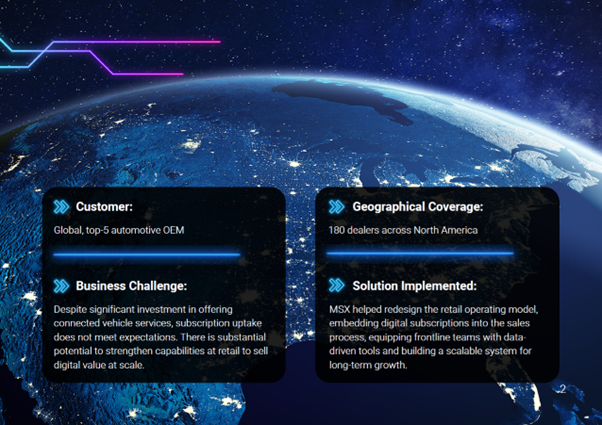
Global, top-5 automotive OEM

Despite significant investment in offering connected vehicle services, subscription uptake does not meet expectations. There is substantial potential to strengthen capabilities at retail to sell digital value at scale.

180 dealers across North America

MSX helped redesign the retail operating model, embedding digital subscriptions into the sales process, equipping frontline teams with datadriven tools and building a scalable system for long-term growth.

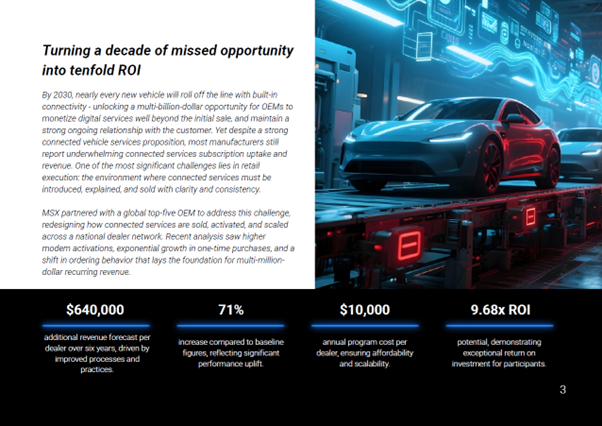
Turning a decade of missed opportunity into tenfold ROI

For years, connected vehicle subscriptions have been treated as a product challenge: build the features, and adoption will follow. Yet many automotive brands still face underwhelming uptake because the “last mile” of retail is not optimized to sell digital value. MSX International partnered with a global top-five OEM to redesign the retail operating model, embedding digital services into the sales process and equipping frontline teams with the data-driven tools needed to succeed at scale.

This report focuses on transforming connected services from a retail challenge into a sustainable, recurring profit stream. It shows how a structured approach to coaching, data discipline, and retail enablement can deliver exponential growth in digital purchases and modem activations. Moving from hardware to software monetization requires more than just new technology—it requires a shift in the entire retail mindset to capture value across the vehicle’s lifetime.

Download the full case study to discover how MSX International can help you redesign your retail operations, improve subscription uptake, and turn connectivity into a high-impact growth engine.

To stay informed about upcoming reports and events from MSX, submit your detail below.
Don’t miss out on new insights and discussions with our leadership team.

We’d love to hear from you

If you’d like to know more about MSX or how we can support your business, please fill out the form below.


Related case studies

Five pillars powering modern mobile service excellence

Five pillars powering modern mobile service excellence

As customer expectations rise and operational challenges mount, dealerships are becoming architects of mobility experiences that are personalized, on-demand, and seamlessly woven into the fabric of daily life. The pressure to deliver service “anytime, anywhere” is reshaping the very foundations of automotive aftersales, demanding new levels of agility, innovation, and customer-centricity. In this landscape, mobile service programs have emerged not as a fleeting convenience, but as a strategic lever for sustainable growth, enduring loyalty, and operational resilience.

This report dives deep into the forces driving this transformation, revealing how forward-thinking dealerships are leveraging mobile service to unlock new capacity, overcome technician shortages, and redefine what excellence looks like in a connected world. By embracing technology, investing in workforce development, and reimagining the customer journey, industry leaders are setting new standards for service delivery – meeting customers where they are, and turning every interaction into an opportunity for lasting engagement.

To stay informed about upcoming reports and events from MSX, submit your detail below.
Don’t miss out on new insights and discussions with our leadership team.

We’d love to hear from you

If you’d like to know more about MSX or how we can support your business, please fill out the form below.


Related Articles