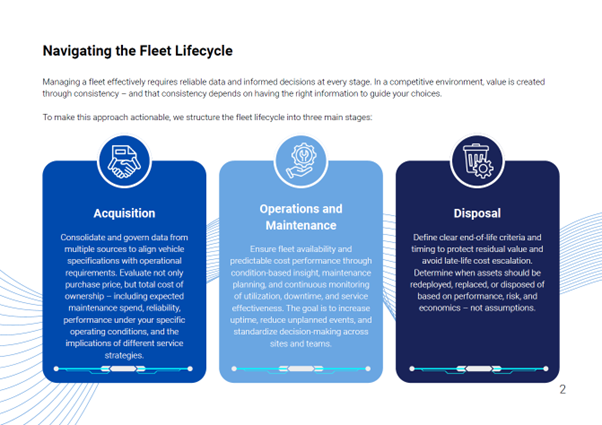
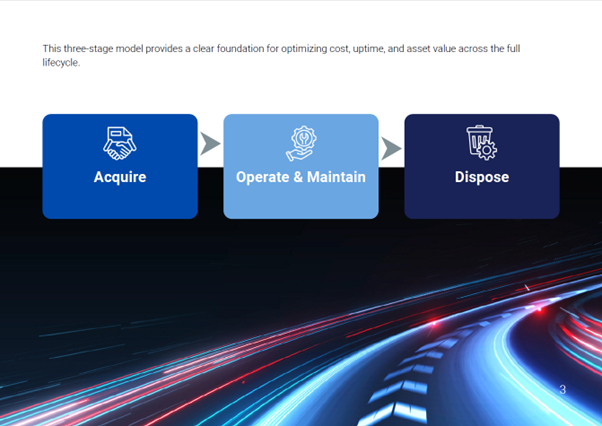
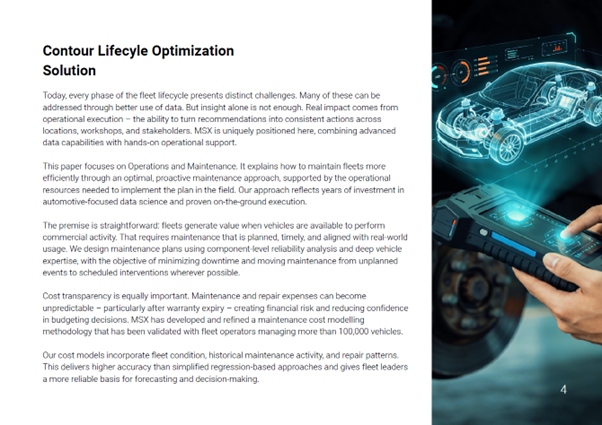
There is a point in every fleet lifecycle when earlier decisions become visible. It may happen when maintenance costs rise sharply after warranty. It may happen when vehicles spend too much time off the road. Or it may happen at remarketing, when the final value of a vehicle reflects everything that came before it. Although these issues may appear unrelated, they often share the same root cause: the decisions made throughout the vehicle’s lifecycle.
Fleet performance is not defined by one event. It is shaped by thousands of decisions about maintenance, repairs, vehicle use, supplier performance, data management and customer support. Every decision influences the next stage of the lifecycle.
As fleet operations become more complex, understanding these connections is becoming a competitive advantage.
Looking beyond individual events
Many organizations still manage fleet operations as a series of separate activities. Maintenance, operations, procurement, finance and remarketing each focus on their own priorities. This approach creates blind spots. Maintenance teams monitor repairs. Finance measures cost. Operations track vehicle availability. Customer teams focus on service quality. Remarketing teams concentrate on residual values. Each perspective is valuable, but none provides a complete picture.
For leasing companies in particular, every part of the vehicle lifecycle is connected. Decisions that reduce costs today may increase downtime tomorrow. A repair completed quickly may influence future resale value. A gap in service history may only become visible when the vehicle reaches the used vehicle market.
Managing these activities independently makes it difficult to understand how today’s decisions affect tomorrow’s performance.
Maintenance is an investment, not simply a cost
Maintenance provides one of the clearest examples of this connected thinking. It is often viewed as an operational requirement or a cost to control. In reality, it is one of the strongest drivers of vehicle uptime, customer satisfaction and long-term asset value.
The more important question is not whether a vehicle has been maintained. It is whether it has been maintained in a way that protects performance throughout the rest of its lifecycle.
A recent project by MSX demonstrates this clearly. Working with a middle-mile logistics provider, the team analyzed warranty and maintenance data as a large proportion of the client’s fleet approached the end of its warranty period. Rather than waiting for repair costs to increase, the objective was to understand where future risks were likely to emerge.
Using reliability modelling and survival analysis, MSX identified how failure rates for key vehicle components would change over time and mileage. This enabled the client to move from reactive repairs to a more targeted preventative maintenance strategy.
The findings were significant. Without intervention, major repair costs were projected to increase by 227% after warranty expiry. A more proactive maintenance strategy had the potential to avoid up to US$13 million in annual repair costs.
The figures themselves are specific to this project, but the lesson is universal. The decisions made while a vehicle is in service have a direct impact on future operating costs, uptime and asset value.
Electric vehicles introduce a new lifecycle challenge
The growth of electric vehicles (EVs) makes lifecycle management even more important. Although EVs simplify some aspects of maintenance, they also introduce new considerations. Battery health, charging behavior, software updates, thermal management and diagnostic capability all influence vehicle performance throughout its life.
Two EVs with identical mileage may have very different long-term value depending on how they have been operated and maintained. This becomes particularly important when vehicles reach remarketing. Buyers are no longer evaluating only the vehicle itself. They also want confidence in the condition of the battery, the quality of the service history and the availability of accurate technical information. That confidence cannot be created at the point of resale. It must be built throughout the vehicle’s operational life.
For leasing companies, this makes lifecycle management as much a commercial discipline as a technical one.
Remarketing begins much earlier than resale
Remarketing is often viewed as the final stage of the vehicle lifecycle. In reality, it reflects everything that came before it. Residual value is influenced by maintenance quality, repair decisions, damage management, service documentation, refurbishment planning and vehicle condition. Every stage contributes to the final outcome.
For EVs, documentation becomes even more valuable. Clear records of battery condition, software updates and servicing help reduce uncertainty for buyers and support stronger resale values. This means protecting residual value cannot be left to remarketing teams alone. It requires organizations to ask broader questions throughout the vehicle’s life.
When these questions are considered earlier, remarketing becomes a measure of lifecycle performance rather than simply a sales process.
From more data to better decisions
Most fleet organizations already possess extensive operational data. The challenge is not collecting more information. It is connecting the information that already exists.
A rise in maintenance costs may indicate changing component reliability. Increased downtime may highlight supplier performance issues. Battery health data may become an indicator of future residual value. Missing service records may reduce buyer confidence long before a vehicle reaches the used market. Viewed individually, these signals offer only limited insight. Viewed together, they provide a clearer understanding of where operational risk is developing and where intervention will have the greatest impact.
Technology plays an important role, but data alone is not enough. Effective lifecycle management combines data with operational expertise, enabling organizations to make decisions that are commercially sound, technically practical and focused on long-term performance.
A more connected approach to fleet performance
Fleet and leasing companies face increasing pressure to improve efficiency while controlling costs, maximizing uptime and protecting residual values. At the same time, the transition towards more diverse fleets, changing customer expectations and increasing operational complexity means traditional approaches are becoming less effective.
The next stage of fleet performance will not come from optimizing individual processes in isolation. It will come from understanding how every stage of the vehicle lifecycle influences the next. MSX helps organizations connect these dots, transforming individual decisions into a cohesive strategy that protects asset value and improves long-term profitability.
Connect with us today to move beyond managing individual events and start mastering the lifecycle intelligence that drives your fleet’s total performance.
Contact the Author
Amedeo Raise