If every operational dashboard is showing green, why is the bottom line still feeling the squeeze?
A vehicle can move through onboarding, maintenance, billing and remarketing without any single process appearing to fail. Yet delays, incomplete records and decisions made without the full picture can affect availability, cost and asset value throughout its life.
These connections become even more important as electric vehicles (EVs) enter the fleet. Vehicle choice, charging, driver needs, maintenance requirements and remarketing cannot be planned effectively in isolation.
Throughout August and September, MSX explored the pressures facing fleet operations and invited its LinkedIn audience to share where they see the greatest challenges. Through a series of polls, we asked about vehicle uptime, connected data, billing, electric vehicles and remarketing. The responses offer a snapshot of participants’ views rather than a representative industry study. Together, they raise an important question for fleet leaders: are we managing each stage well while missing what happens between them?
Uptime is a lifecycle issue
When asked which lifecycle stage presents the greatest opportunity for efficiency gains, 54% of respondents chose maintenance and uptime management.
The prominence of maintenance makes sense. When a vehicle is unavailable, the effect extends beyond a repair booking. Fleet teams may need to arrange alternative transport, respond to a driver, adjust schedules and manage the cost of keeping that vehicle off the road. Maintenance decisions can also influence its condition, service record and value later in life.
This is why uptime should not be judged solely by how quickly a workshop completes a job. Fleet operators also need to consider whether maintenance could have been planned earlier, whether the right information was available and whether the outcome can improve the next decision.
Within MSX’s end-to-end lifecycle approach, Lifecycle Optimization powered by Contour applies advanced analytics and vehicle expertise to the operation and maintenance phase. It helps teams plan interventions around how their fleet operates, improve cost visibility through AI-driven dashboards and protect the productive life of their vehicles.
EV planning starts before the vehicle enters service
For electric fleets, uptime also depends on decisions made before and during operation.
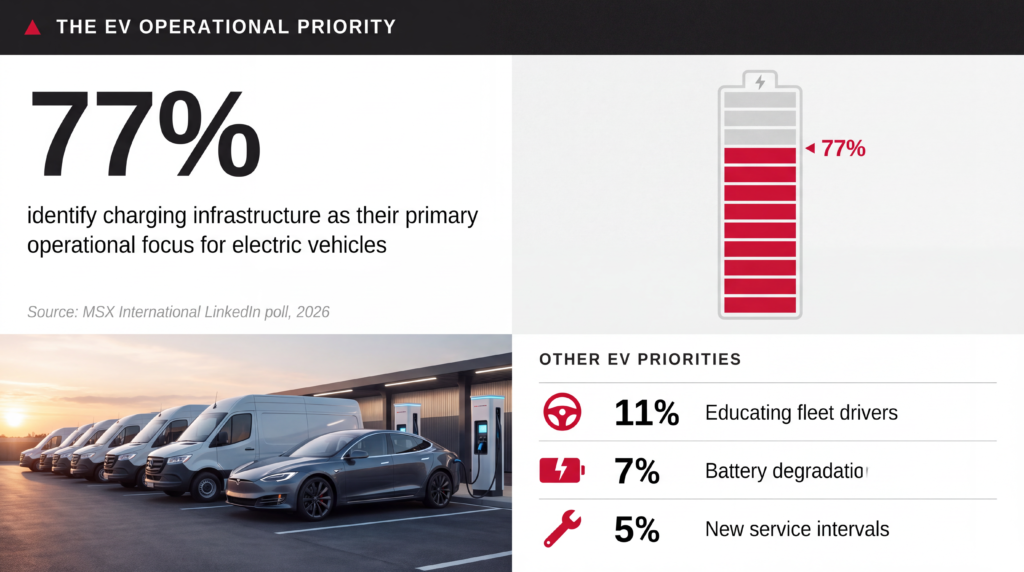
In our EV poll, 77% of respondents selected charging infrastructure as their primary operational focus, ahead of educating fleet drivers, battery degradation and new service intervals.
Charging infrastructure is clearly important, but it is part of a wider operational picture. Vehicle selection, routes, schedules, driver needs and the time available between journeys all influence whether an electric vehicle will be ready when required. Maintenance planning must also reflect different service needs and usage patterns.
This makes electric vehicle planning a lifecycle consideration rather than a separate workstream. Connecting early vehicle decisions with operational data and driver experience gives fleet teams a stronger basis for managing availability, cost and long-term asset value.
Data must support the next decision
Connected vehicle data can help teams make that connection, but access to data does not guarantee action.
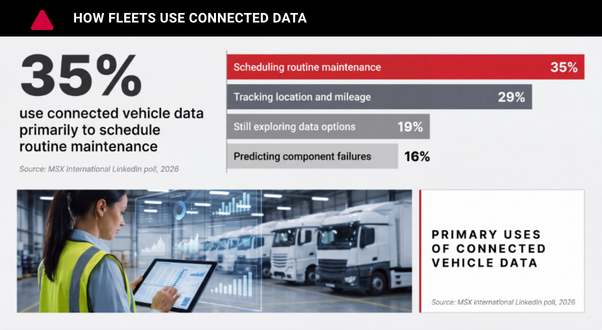
Asked about their primary use of connected vehicle data, 35% of respondents selected scheduling routine maintenance and 29% selected tracking location and mileage.*
Both uses can support day-to-day operations. The greater opportunity is to combine vehicle usage data with service history and operational requirements. This can help teams identify risks and decide what to do before an issue disrupts the fleet.
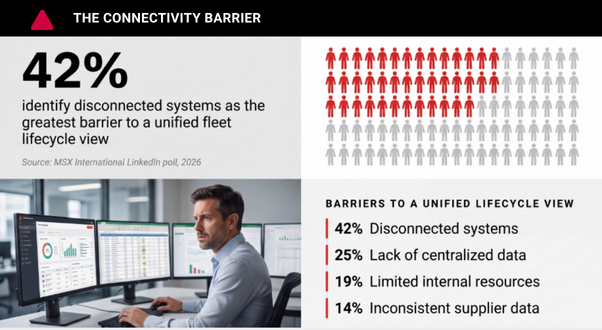
Achieving that requires a clear view across systems. In another poll, 42% of respondents identified disconnected systems as the greatest barrier to a unified lifecycle view.
The problem is not always a lack of information. Booking, service, charging and fleet data may all exist, but sit in different places. When teams have to assemble that information every time a decision is needed, opportunities to act early can be lost.
MobilityNext uses advanced AI to support this part of the wider lifecycle by helping long-term rental providers and mobility operators bring data, workflows and guidance into an integrated platform. It connects activities from pre-lease vehicle selection and relief bookings to fleet monitoring and remarketing, giving teams a clearer operational view as vehicles and customers move between stages.
Look beyond the cost of a repair
The service network is where many lifecycle decisions become visible. A repair may follow the agreed process, but if the fault returns or the vehicle remains unavailable longer than expected, the wider operation still carries the impact.
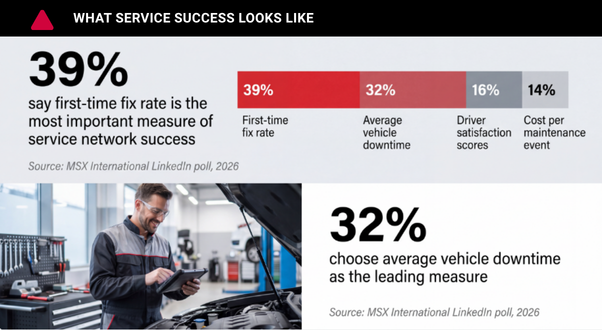
When asked which metric matters most when evaluating service partners, respondents pointed firmly towards operational performance: 39% selected first-time fix rate and 32% chose average vehicle downtime. Cost per maintenance event received 14%, while driver satisfaction received 16%*.
These responses do not make repair cost irrelevant. They suggest that, for these participants, an effective repair and a prompt return to service matter more than the price of an individual event. Fleet leaders should therefore consider whether their measures capture the operational outcome of service as well as the transaction. This includes the effect on vehicle availability, the driver and the vehicle’s longer-term condition.
Billing is part of the same process
The connection between service and finance is easy to overlook until a query arises. An invoice that does not match an approved claim, or arrives without clear supporting information, can involve several teams before it is resolved.
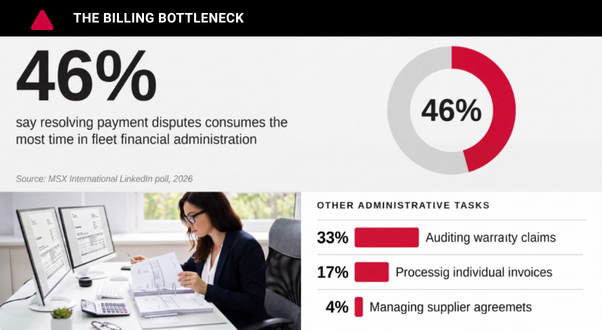
In our poll on financial administration, 46% of respondents selected resolving payment disputes as the task that consumed the most time.
This raises another lifecycle question: how much administrative work is created because information does not move cleanly from the service event to the invoice?
MSX Central Billing connects service, parts and invoicing through a standardised workflow across the dealer network. It matches transactions to approved claims and consolidates them into an invoice with supporting detail. This gives fleet and finance teams a clearer route to review spending and address queries.
Central Billing is therefore more than a finance process. It helps carry accurate information forward from maintenance and repair, supporting stronger cost control across the vehicle lifecycle.
The value of a record becomes clear at remarketing
The effects of earlier decisions become visible again when a vehicle leaves the fleet. At that point, teams need a reliable account of its use, condition and maintenance rather than a last-minute search across separate systems.
Asked which factor carries the most weight when remarketing vehicles, 63% of respondents selected a complete service history. This reinforces a practical point: a complete service history is built during the vehicle’s working life. Every properly recorded maintenance event makes it easier to understand, prepare and present the vehicle when it reaches disposal.
The MSX Fleet and Remarketing Solution provides the wider operating model for this connected approach. It brings people, processes and technology together across six stages: offer, order, in-fleet, operation, de-fleet and remarketing.
Structured workflows and centralized asset visibility help teams manage the transition between these stages. At de-fleet and remarketing, condition data, documentation, valuation and sales-channel decisions can then form part of the same coordinated process. This helps fleet operators manage assets more proactively, reduce delays and protect residual value.
One lifecycle, supported by connected capabilities
The polls point to distinct priorities, but they also show how closely those priorities are linked. Better maintenance decisions need usable data. Electric vehicle availability depends on choices made across infrastructure, operations and driver support. Service performance affects uptime, while accurate claims and invoices support financial control. Complete records help teams prepare vehicles for de-fleet and remarketing.
Lifecycle Optimization powered by Contour, MobilityNext and Central Billing support specific needs within this journey. MSX brings these capabilities together within a broader fleet and remarketing approach, helping organizations connect information, workflows and decisions from vehicle selection to final sale.
For fleet leaders, the starting point is to identify where those connections are weakest:
Fleet value rarely disappears in one dramatic event. More often, it leaks away through delays and gaps that are difficult to see when each stage is managed separately.
By combining automotive expertise, AI-powered innovations and hands-on service, MSX helps fleet and mobility organizations manage the vehicle lifecycle as one connected operation.
Where does your fleet feel the friction?
If you are looking to identify where disconnected processes may be affecting your bottom line, request a call-back from the MSX team.
*Poll results are shown as reported by LinkedIn. As these figures are rounded to whole percentages, totals may not always equal 100%.